
|
|||||||||||||||||||
|
|
Jim's Redesigned Router Table
March 03, 2009
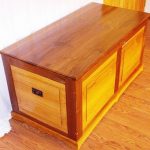
by Jim Stack ![]() This is how I'm hoping the redesigned router table will appear. (So far, so good.) This first installment will show you how to make the cabinet. In proceeding installments, I'll show you how to make the drawers, fence and the all-important router carriage lift mechanism.
This router table design is a composite of ideas I’ve seen and used over the years. What sets this router table apart from the others is the router carriage lift mechanism. It holds the router and controls the up-and-down adjustment without having to stand on your head or lift the whole top, carriage and router to change bits. All I need to do is open the top (it's hinged on the back), grab my wrenches and go to it. I then flip the top down and I'm ready to go. It has proven its durability as I've used it for the past four years. I've added detailed plans and instructions showing how to make the router carriage/lift and the table. A few weeks ago I looked up, in my garage, and saw a bunch of 1×4×8' yellow pine boards just collecting dust. (I recently moved into this house and learned that this wood has been in the garage for about 12 years.) It was my favorite price (free) and it’s definitely dry. So, this new router table has a raised-panel back and sides and matches my rolling tool chest (see Building the Perfect Tool Chest, project 6) that is made from old pallets. The hardware for this router table is available at any home improvement center or hardware store. The top and insert are available from a manufacturer (I've named the supplier in the parts list), but I’ve included the materials you’d need to make your own top. With a router table, I recommend using a 3-hp router. It makes it easier to use large cutters, and the final cuts are smoother and cleaner than using a smaller-horsepower router. When using a router table and a large horsepower router, you need to be aware of some safety concerns. What we’ve done is turn our router into a stationary power tool called a shaper. Any commercial woodworker who has used or been around a shaper will tell you it can be the most dangerous power tool in the shop. Shapers and routers spin at incredibly high speeds — the speeds vary from 5,000 to 20,000 rotations per minute. That’s more than 150 to well over 300 rotations per second. The speed at which things can be thrown from the cutters is about 100 miles per hour. None of us can think that fast. That’s why we use feather boards, push sticks and shrouds around the cutters to protect our fingers, hands, eyes and other body parts. Whenever I'm making a setup on the router table, I run through my mental checklist. Is the collet nut tight and the router bit secure? Is the fence set correctly and tightened down? Are other attachments securely in place? Then I run through it one more time — check twice before powering up. ![]() These are photos of my original router table. It has served me well for the past 4 years, but it was time for a face lift and some drawer-space redesign. ![]() ![]() I cut the lumber to rough lengths for the legs, rails and panels. Then I took the lightest pass over my jointer that I could to clean up one face of each board. I then ran each piece through my planer, again making a cut just deep enough to clean up the board. The originally thickness of the boards was 3⁄4" and the final was 11⁄16"
![]() I jointed one edge of each of the panel boards, then cut the other edge on the table saw. I then jointed this saw-cut edge.
![]() Glue up the panels first so the glue can be drying while you work on the leg parts and rails.
![]() Align the pieces and clamp them together. Be sure to have clamps on opposite sides of the panel for even clamping pressure.
![]() Cut the rails to length. Be sure to allow for the 1" tenons. Notice the flipper on my stop. I flip it up and slide the part under the flipper. This makes the cut about 1⁄4" longer than the final length.
![]() When you rotate the part end-for-end, the flipper will drop down. Butt the part against it and make the final cut.
![]() For the longer-length leg parts, I squared up one end ...
![]() ... then I slide this square end against the saw's fence (which has been set to the correct length of the leg part) and made the final cut. This is a safe cut because the sled supports the leg part as it rides along the fence.
![]() Lay all the leg parts against a carpenter's square and clamp them together. Mark the locations of the mortises.
![]() ![]() I cut the mortises using a brad-point drill bit. I used a mortising jig that I made for the book, The Best Jigs & Fixtures for Your Woodshop. By setting my drill press at its highest rotating setting (about 2,500rpm), I'm able to make a clean-cut mortise. Nice! ![]() ![]() Yes, I'm using my original router table to cut the grooves for the raised panels. It's simply a matter of connecting the mortises. Lower the leg part so the router bit is in the mortise and cut until you come to the other mortise. Then cut the panel grooves in the rails. These run the entire length of the parts. Remember, no grooves in the top and bottom front rails and front leg parts. ![]() ![]() I used the same bit that I used to cut the grooves to cut the tenon faces and the edges ![]() ![]() Now I started work on the panels. I cut them to size and leveled them using a hand plane and a random-orbital sander. To "raise" the panels, I used my table saw. After cutting the panel bevels, I cut the 45° bevels on the leg parts. Be sure to make 4 right-hand and 4 left-handed parts! ![]() ![]() ![]() Pair the leg parts and lay them out with the sharp edges of the bevels touching. Run a piece of masking tape along the joint. Flip this assembly over and apply glue to the bevels. Then fold the assembly. Make sure the leg parts form a square and let the glue dry. ![]() Glue the foot blocks in place and assembly the front and back sections.
![]() After the glue is dry, attach the front and back assemblies together. The cabinet is now assembled.
Click here for PDF file. Jim is Senior Editor for Popular Woodworking books |
|||
| ||||
![]() |
Learn more about related publications and services produced by F+W Media: |